Tuesday, December 27, 2016

1954 Mercury Sun Valley And 1954 Ford Sunliner

1954 Mercury Sun Valley, from factory sales literature.

During the dream-car days of the 1950s, it seemed as if anything could have found its way onto the car of the future. Oftentimes, some subtle version ended up on the production models a few years down the road. And while the GM dream cars are far better known than their crosstown counterparts, the 1954 Ford Skyliner–and Mercury Sun Valley–can thank the 1953 Ford XL-500 for a clear view of the sky.
Clear tops were not all that new to the automotive world when the 1954 Ford Crestline Skyliner hit the showroom floor. Though the hardtop is generally considered the first mass-produced regular production car with a Plexiglas roof panel, it was actually the same-year Mercury Sun Valley that left the assembly line first–Ford just outsold it.
As mentioned, FoMoCo used Plexiglas, tinted blue-green (visually, it’s green), measuring one quarter-inch thick. The plastic was set into a rubber gasket, inserted into the rest of the roof, and surrounded by polished stainless steel. The transparent piece sat directly over the entire front seat. Structurally, one might think it would be a hindrance, but so long as all four wheels were still on the ground, there wasn’t much of a difference, as Ford used the beefed up convertible chassis.
The new models were advertised as a novel way to view the countryside; a more panoramic view, or certainly an advantage in viewing overhead traffic lights. Of course, the next thought to cross one’s mind might be the increased heat issue. To this, both Ford and Mercury claimed that the interior temperatures would increase only slightly, perhaps a nominal five degrees. In a Special Interest Autos November-December 1976 interview with designer L. David Ash, he claimed that “60 percent of the sun’s heat rays and 72 percent of the glare” were blocked by the tint. All the same, both companies offered a snap-in “aluminized nylon” shade to block out the world above.
The 1954 production run culminated with 13,344 Skyliners and 9,761 Sun Valleys. Then the trouble started. Rumors began to quickly circulate of the tendency for the interior to become sauna-like during the summer months, and even with the interior shade in place, the temps rose above the factory claims.
In time for the 1955 model year, Ford nixed the Crestline in favor of the Fairlane, thus moving the “bubbletop” Skyline model into the more popular Crown Victoria models of the mid-Fifties. Also introduced with the Fairlane was the “basket handle” chrome trim. Of little structural value, it’s actually hollow, and it’s where–on the Skyliner–the removable sun shade could be stored when not in use. For the 1954 model year, the shade would have to be stored elsewhere. There was also a change to the shade, in that a zipper ran down the middle so that half the Plexiglas top could be exposed.
Unfortunately, sales began their downward spiral at the rate of a lead brick in a pond. Ford’s 1955 Skyliner production total was just 1,999 units, while Mercury’s wasn’t far behind with 1,787. Mercury killed the bubbletop after the 1955 model year, but Ford continued it in 1956, producing just 603 units. Granted, 1956 wasn’t the best model year for any manufacturer, but when comparing bubbletop production numbers with their regular hardtop siblings, it’s easy to see why the novel idea didn’t last: Ford’s three-year hardtop versus bubbletop total was 137,838 to 15,946, while Mercury’s two-year total was 151,091 to 11,548. Today, they are highly collectible, especially the 1956 models.
The Sun Valley died in the design room, yet the Skyliner was transformed into the retractable hardtop, offered from 1957-1959. However, it’s not the end of the story for the Plexiglas top. It reappeared as the “moon roof,” an option on the 1977 Lincoln. Essentially the same width as the Skyliner plastic panel, it featured a reflective tint rather than blue-green.
So the next time you open your glass panel sunroof, you can thank FoMoCo’s Skyliner and Sun Valley.
This article originally appeared in the January, 2008 issue of Hemmings Motor News.

Source: blog.hemmings.com

1949 Mercury Coupe


Source:  hemmings.com

1965 Mercury Comet Caliente

Rally-prepped 1965 Mercury Comet Caliente for sale on Hemmings.com. From the seller’s description:
This vehicle is a recreation of one of the original Ford Motor Company Mercury Comet rally cars.
Commencing with an exceptionally solid, low-mileage, original car, the rebuild process changed the car into a performance and durable rally car with the following specification: 302 Ford V8 making approximately 300 HP. Five-speed Tremec T5 transmission. Four-barrel carb and reworked headers. Uprated suspension with heavy-duty springs. Rack and pinion power steering. Mustang front disc brakes and 11″ rear drums. Ford 9″ rear end with posi-traction. Front skid plate. Full rally instruments and roll cage. Recaro bucket seats, air conditioning and CD changer. Full spares package with built in lock box. Two sets of extra wheels, 14″ and 15″

Source: hemmings.com
1965MercuryComet_02_1000 1965MercuryComet_03_1000 1965MercuryComet_04_1000 1965MercuryComet_05_1000

1970 Mercury Cougar Eliminator


Source: hemmings.com

1948 Mercury Convertible

1948 Mercury Convertible

Source: hemmings.com

1967-’68 Mercury Cougar XR7

Photos by Daniel Strohl.

For 1967, Mercury took the Mustang uptown with the release of its Motor Trend Car of the Year winning Cougar.
From its quad headlights concealed behind a distinctive electric shaver grille to its triple taillights with sequential turn signals, the Cougar was aimed at the grown-up performance enthusiast who might have otherwise shopped for a European car.
Nowhere was Mercury’s emphasis on sophistication more evident than inside the sporting cat, particularly when outfitted with optional XR7 trim. If you’ve ever peeked inside a Jaguar sedan from this period, then you already know what Mercury’s designers were thinking about while planning the Cougar’s cockpit.
The XR7’s seats were skinned in a rich-looking combination of leather and vinyl, and its door panels were equipped with touring car-esque pull straps and map pockets. An overhead console further gentrified the XR7’s living quarters and served as a place to locate idiot lights that might have detracted from the elegantly simple instrument cluster. Along with the low-fuel warning light, seat belt reminder light, door ajar warning light and the parking brake light, a pair of round map lights were positioned neatly in the console above the driver and passenger.
The XR7’s instrument panel was especially European, trimmed full-width in a walnut-toned simulated woodgrain appliqué, with black-faced instruments. Front and center, flanking the steering column, sat the speedometer with trip odometer on the left and tachometer on the right. Positioned above the speedo and tach were the ammeter, fuel gauge and temperature gauge, while the oil pressure gauge was mounted far to the right on the passenger’s side of the panel.
Aligned in a tidy row at the center of the dash were a bank of toggle switches that controlled the left- and right-side map lights, rear quarter courtesy lights and the instrument panel courtesy lights.
If an optional sports console was ordered, it extended upward at the center of the instrument panel and provided a home for an electric clock and optional radio.
Mercury’s attempt to imbue the Cougar with British touring car touches wasn’t lost on reviewers of the day. In its March 1967 issue, Popular Mechanics even put two-time Indianapolis 500 champion Roger Ward behind the wheel of a 1967 Cougar XR7 390 GT and asked him to compare it against the 1967 Aston Martin DB6. The Cougar, loaded with every available option, carried a reasonable $4,450 price tag, while the DB6 checked in at $15,400.
When the smoke cleared, Ward seemed impressed with the Cougar’s 390 powerplant, but noted the car’s unsports-car-like tendency to understeer–probably in no small part due to the weight of its V-8 engine. The DB’s sophisticated all-aluminum 244-cu in DOHC six-cylinder, meanwhile, was at a slight disadvantage in a sprint, but it paid the driver back with a favorable power-to-weight ratio that made the Aston far more willing to hang out its tail in a high-speed turn.
“I’d say the Cougar is a car for the man who aspires to own an Aston Martin, but hasn’t got the pocketbook for it!” Ward said. The same could be said today of the XR7–an often underrated, overlooked but stylishly appointed American performance car.
Mercury Cougar XR7 Mercury Cougar XR7 Mercury Cougar XR7
This article originally appeared in the October, 2013 issue of Hemmings Motor News.

Source: hemmings.com

The Eliminator: 1970 Mercury Cougar

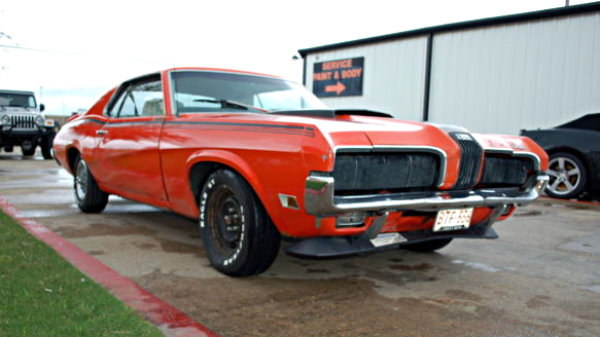
1970 Mercury Cougar Eliminator
I grew up hearing amazing stories about the Mercury Cougar. As you may recall, my dad has always wanted a Cougar, even just a base model. He eventually found one that he likes, so hopefully he doesn’t see this Cougar Eliminator and decide he needs another! This example is believed to be highly original, although the paint has been touched up and a few pieces have gone missing over the past 46 years. The seller has gotten it running and driving, with a new exhaust system, and it’s listed here on eBay in Wylie, Texas with a BIN of $18,500 and the option to make an offer.


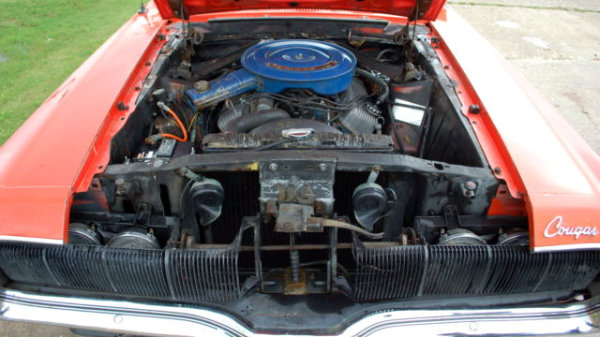
1970 Mercury Cougar 351 4V Engine
$18,500 is a bit rich for my blood, but this Eliminator is a special car. It was special ordered by the first owner in Competition Orange paint, with the 351 4V engine, FMX transmission and the Rally Wheel covers. The handling package, 3.25 rear end and F70x14 tires were standard with the 351 Eliminator, but are nice features to have and sure made it a great car! There were just 2,267 Eliminators built in ’70, but it’s believed that only 3 of those came with the Rally Wheel covers and this could be the only one of those painted Competition Orange. I love the looks of this car, especially with those hide away headlights!


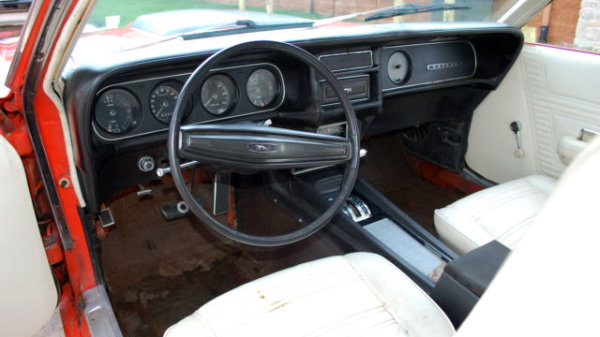
1970 Mercury Cougar Interior
This car’s history is a bit interesting. It was kept and cared for by the original owner until about 5 years ago. The next owner pulled the exhaust off, removed the headliner, carpets, then parked it and left it. It’s too bad they decided to pull it apart, it would likely be a much nicer survivor if they had continued to maintain it instead. I’m going to guess they were planning on restoring it, but lost interest or ran out of funds. It’s also a bummer that the parts they removed aren’t still with it, but they may have been past the point of saving. At least the new exhaust looks and sounds great!

 
While it’s a well optioned car, most Eliminators were, and looks to be in solid shape I think the current asking is a tad high. Thankfully the seller is willing to hear offers, so perhaps they will accept an offer closer to $15k. If you make them an offer, be sure to let us know! So do any of you have good stories or memories of the Eliminator to share? If so, we would love to hear them!
 
Source: barnfinds.com